










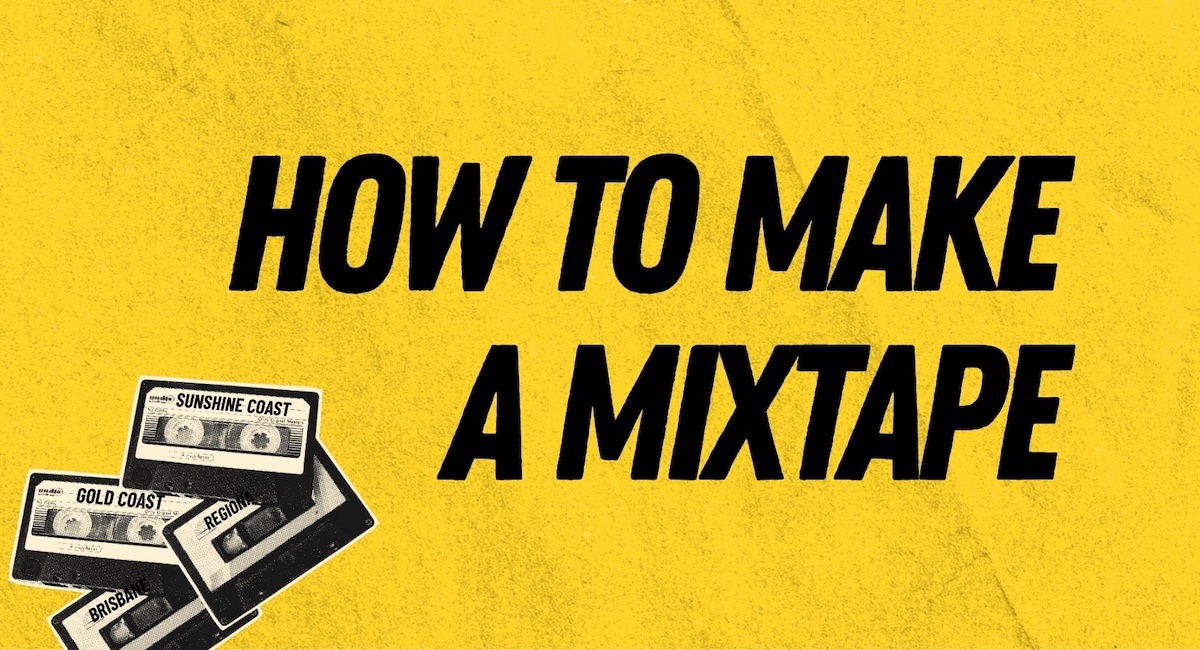
One finger on record, one ear on Rick Dees Weekly Top 40 and absolutely no patience for anyone talking over the intro. Three decades later, the cassette player is gone, but the urge to catch songs, keep them and pass them around has never left. Penny Brand writes.
Imagine this. It is 1993. School is done, dinner is finally over and you are stretched across a single bed in your flannie PJs, with the cassette player you got for your birthday tucked in beside you.
Then the song you have been waiting all week to catch finally comes on.
You lunge for the red button.
For the next week, you play it until you absolutely hate it, then erase it to make room for your next great musical obsession.
By Grade 6, I had already swallowed the music propaganda pill whole.
The radio was my only outlet to the rest of the world, and every song that came through it felt like contraband.
My tapes were a glorious smorgasbord of ’90s hip-hop, R&B and whatever lyrics I had learned by heart from Smash Hits.
Snoop Dogg, Salt-N-Pepa, MC Hammer, Vanilla Ice, Kris Kross, East 17 and Snow were all on high rotation.
Snow was the Canadian rapper behind “Informer” (you-know-me-daddy-Snow-blam-a-licky-boom-boom-down) which none of us could sing correctly but somehow performed with absolute conviction.
These were my earliest days as a highly committed music pirate.
If somebody threw a banger into the Top 40, I wanted it.
Recording songs from the radio required precision, patience and a very low tolerance for announcers. You had to hit the button at exactly the right moment and pray the talking stopped before the first verse.
Sometimes you caught the song perfectly.
Other times, your treasured recording began with the tail end of a joke, a weather update or half a sentence you never asked for.
That was part of the charm.
The obsession did not stop at recording songs. I wanted to get closer to the whole strange world coming through the speakers.
When I was about 12, I called a local Toowoomba radio station to request “Finally” by CeCe Peniston, a song permanently linked to my first real crush.
Somehow, that call also won me a XXXX beer pack.
I convinced my friend and her little brother to walk to the station with me, then the three of us carried a six-pack, cooler bag, T-shirt and assorted beer-branded treasures home.
Apparently nobody saw a problem with this.
By Year 11, my best friend and I were ringing triple j whenever we could. Jane Gazzo seemed happy to let us go on air and say ridiculous things.
Once, my friend announced to the nation that the boy I was hopelessly in love with had “lost his swimming trunks in the pool at the school carnival today”, a detail she had simply plucked from thin air.
We were beside ourselves that our insignificant teenage lives had “briefly” been broadcast across Australia.
Somehow, radio is still part of mine.
I now talk music with former triple j presenter Sarah Howells on ABC Sunshine Coast every Tuesday while continuing to make mixtapes through YELO.
Apparently I have not changed much.
Step 1: Build a place to catch songs
More than 10 years ago, around the same time I became a single mum, I needed a system that was quick, simple and easy to keep up with.
In came the digital playlist.
I had not made a real mixtape since the cassette years, but this felt like my cue to bring the obsession back.
The cassette was gone, but the instinct was exactly the same: catch the song, save it and pass it around.
I am now up to Mixtape 24, not including the countless other playlists I have made for every possible person, mood and minor emergency.
They range from Mumma’s Angsty Car Music to Best Xylophone Solos or the classic Penny’s Happy Tracks, which earlier came on a CD if you were lucky enough to receive one.
Apparently my need to soundtrack absolutely everything survived.
The first step is simply to give the songs somewhere to go. Start one playlist and keep adding to it. Do not wait until you have a theme, a clever title or a carefully considered musical direction.
The song comes first. The organising can happen later.
Step 2: Save the song immediately
Songs now arrive from everywhere.
A local band catches my attention. One of my kids takes control of the car stereo and plays something at an obscene volume. A musician I already love releases something new.
Sometimes an ’80s banger comes over the speakers at Woolies and suddenly the frozen-food section feels cinematic.
That one goes in the bag.
The rule is simple: do not assume you will remember the song later.
You will not.
Tap the title. Save it. Screenshot it. Shazam it. Write that shit down.
Sometimes I hear a song when I cannot check my phone, so I choose one line from the lyrics and repeat it inside my head until I can search for it.
The challenge is to hold onto the line without changing a word or allowing another thought to enter the building.
Then I type my slightly incorrect version into Google and hope it understands.
Shazam is easier, obviously, but sometimes we must return to the ancient ways.
Step 3: Let the playlist get messy
Each of my mixtapes begins innocently.
A musician I love releases something new, so onto the list it goes. Then one of my kids plays me something. Then a Sunshine Coast band catches my attention. A friend sends a recommendation. An algorithm quietly slides a track under my nose at 11.47pm when I should be asleep.
Before long, the playlist has grown legs and wandered in several different directions.
There might be noisy local punk beside dreamy teenage pop, an old song I forgot existed and something my daughter has played so often that resistance has become pointless.
That is exactly how I like it.
A mixtape should be a mixed bag.
Do not build it for an imaginary person with an enormous vinyl collection and extremely serious opinions.
Add the pop song you are slightly embarrassed to love. Add the local band with 73 monthly listeners. Add the track that rescued your gym session and the one that makes you drive differently.
The playlist should sound like your actual life.
Step 4: Let other people interfere
Some of the best songs on my mixtapes came from my children, friends, local artists and people who sent me recommendations.
A collaborative playlist lets them interfere directly.
Instead of another family group chat filled with messages about milk, missing chargers and why nobody has replied, make a shared playlist and let everyone add songs.
Move over, WhatsApp family chat.
The family can now ignore each other somewhere with a soundtrack.
You can do the same with friends. Build one for a road trip, a party, songs you all loved at 17 or music you believe the others urgently need in their lives.
The tracks will not always make sense together.
That is what makes it good.
A mixtape does not need to sound professionally curated. It should sound like the people who made it.
Step 5: Make it weirdly specific
The best playlists are often the ones with the most ridiculous titles.
Mumma’s Angsty Car Music exists because sometimes a woman needs to drive around while processing several emotions at once.
Best Xylophone Solos exists because apparently I once decided the world needed it.
The more specific the idea, the more useful the playlist becomes.
Make one for the songs your kids introduced you to. Make one for the year you discovered eyeliner and bad decisions. Make one for cleaning the house while furious.
Make one for the songs that belonged to a particular car, house, friendship or version of yourself.
That is when a playlist stops being a pile of songs and starts becoming a memory.
Step 6: Edit it after it gets unruly
Do not overthink the playlist while you are building it.
Throw everything in first.
The cassette era did not allow this kind of recklessness. Every song consumed precious tape, and removing one could mean rebuilding the entire thing.
Digital mixtapes are far less permanent.
A song can disappear at the flick of a switch. Another can slide straight into its place. You can test a track for a week and delete it the moment it begins to annoy you.
So collect first.
Be ruthless later.
Eventually, you will notice the songs you skip every time and the tracks that never quite earned their place.
Out they go.
The big edit is when the mixtape finally tells you what it wants to be.
Until then, leave the gate open.
A mixtape becomes a record of where you were, who you were with and what managed to reach you at that point in your life.
Twenty-four mixtapes later, I am still doing exactly what I did on that single bed in 1993.
Waiting for the next song to arrive and getting ready to catch it before it disappears.
Hear the Pineapple Mixtapes
YELO’s Pineapple Mixtapes bring together Queensland music, new discoveries and songs worth carrying around for a while.
Start listening on Spotify:





What do you think?
Show comments / Leave a comment