








Modern life promised freedom.
But somewhere in the middle of all that convenience, a lot of people ended up lonelier, more scattered and less connected to the places they live.
We can work from anywhere, move anywhere, stream anything and stay connected all day. But for all that connection, a lot of people still feel disconnected from the places they actually live.
Across South East Queensland, the answer might not be grand or complicated. It might be as simple as getting people back into rooms together.
A pub show. A local hall. A festival campground. A Sunday session. A small stage in a coastal town where half the crowd knows the band, someone’s uncle is doing sound and the person beside you turns out to know your neighbour.
That might not sound revolutionary. But in a world where so much of life now happens through screens, feeds, delivery apps, remote work, group chats and private stress, standing in a room with other people can feel like a small act of repair.
Community does not always arrive as a big idea. Sometimes it starts with knowing what is on this weekend.
The quiet loss of local life
The last few decades have given people more options than ever.
People can leave home for work, study, cheaper rent, better opportunities or a different version of themselves. Families stretch across cities. Friends move away. Parents raise kids without the backup of nearby relatives. Local shops disappear. Music gets streamed alone. Work follows people home. Everyone is contactable, but not always connected.
The result is strange. People can have hundreds of online connections and still feel like they do not belong anywhere in particular.
They can know what is happening overseas before they know what is happening at the pub down the road. They can stream any song in the world, but never see the local band playing ten minutes from home. They can live in a town for years and still feel like they are passing through it.
That is not just a personal problem. It is a cultural one.
A place needs more than houses, roads, shops and schools to feel alive. It needs gathering points. It needs low-pressure reasons for people to leave the house. It needs places where people can run into each other without booking three weeks ahead.
It needs rooms.
Live music brings people together
Live music is one of the few remaining parts of public life where people still gather for something that is not purely transactional.
You are not just buying a product. You are entering a room.
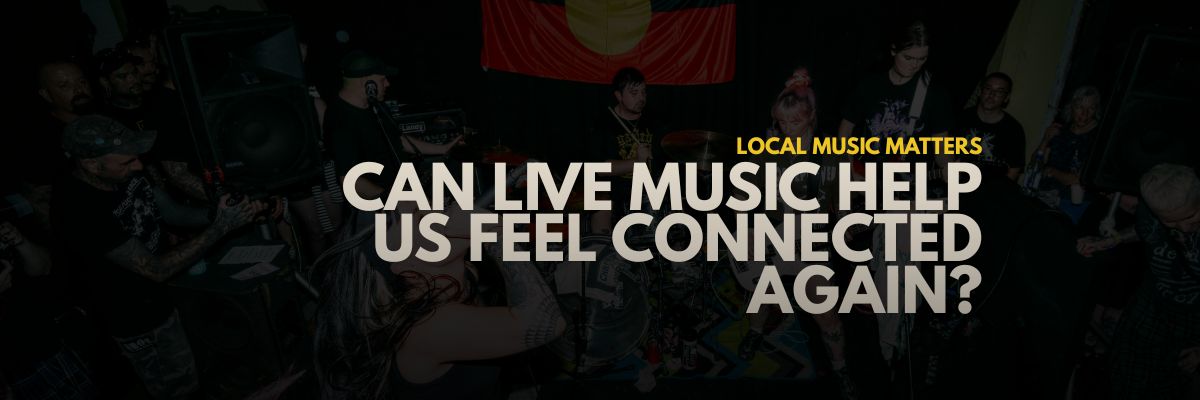
You hear the soundcheck. You stand near strangers. You see someone you vaguely know. You discover a support act. You talk to the person at the bar. You watch a band try something that may never happen the same way again.
For a couple of hours, people are not just scrolling separately through the same bad news. They are in the same physical space, facing the same stage, feeling the same drumbeat through the floor.
That is the point.
For Queenslanders, local culture is often where people remember they belong somewhere. In the small rooms, regional halls, pubs, festivals, breweries, markets and venues that keep people gathering, live music is more than entertainment.
It is community infrastructure.
The small rooms are doing big work
Not every important show looks important from the outside.
Sometimes it is twenty people in a side room. It might be a songwriter playing to a handful of locals, or a young band working out who they are.
Other times, it is a festival run on volunteers, borrowed gear, good faith and a terrifying spreadsheet. It might be a venue that keeps putting on original music even when cover bands would be easier.
These things matter because they create repetition.
A scene is not built by one viral moment. It is built by people showing up again.
The bartender starts to look familiar. You know some people by face, then by name. Someone brings friends next time. The opener becomes the headliner.
That is how a place begins to feel like itself. Not because everyone knows everyone. Because enough people know where to go.
People are tired, not careless
There is a common complaint that people do not care about local music anymore. But maybe that is not the whole story.
People are tired. They are working odd hours, parenting alone, watching money, doom-scrolling, recovering from the week, and trying to work out whether they can afford a night out.
Plenty would go if it felt easier to know what was on. Others might support local bands more often if the path back into the room was clearer.
The distance between staying home and going out is not always laziness. Sometimes it is friction.
A gig guide cannot fix the cost of living. It cannot rebuild every lost venue or make modern life less lonely on its own. But it can lower one barrier.
It can say: here is what is happening. Here is where to go. Here is the band. Here is the room. Here is the night that might be worth leaving the house for.
That is not small. In a scattered world, clear local information becomes part of the cultural glue.
The new village will not look like the old one
Community probably will not return in the old way.
Most people are not going back to living near their whole extended family. The local hall may not be the centre of every town. Work, rent, relationships and opportunity will keep moving people around.
But a new kind of community can still be built. It might be more patchwork. More intentional. More dependent on small rituals.
The weekly gig. The Sunday market. The local festival. The venue where people slowly start recognising each other. The radio segment that reminds people what is on. The website that keeps track when everyone else is too busy. The friend who says, “Come with me.” The band that gives people a reason to gather.
That is how the thread gets tied again. Not all at once. Not perfectly. Not with a grand speech.
One room at a time.
Where YELO fits in
YELO exists because local culture is easier to lose than people think.
A show can happen and disappear. A band can play to a room that should have been fuller. A venue can do good work without enough people knowing. A festival can hold a community together for a weekend, then vanish back into the calendar until someone tells the story.
YELO is here to pay attention.
To the gigs, the venues, the artists, the festivals, the small rooms and the strange local nights that make South East Queensland feel alive.
The point is not just to list events. The point is to help people find their way back to them.
Because a community does not only need more content. It needs more contact.
It needs places to go, reasons to gather and reminders that the world is still happening outside the house.
And sometimes, the first step back is simple.
Check what is on. Pick a room. Go stand in it.